Steam, Soak, Sabotage: The Case for a Smarter Shower

There's a particular kind of American shower that deserves its own museum exhibit. It's the one where you crank the handle all the way to hot, stand there for twelve minutes while the mirror fogs over, and let the water pound your shoulders like a massage you didn't pay for. It feels restorative. It feels like self-care.
Unfortunately, your skin disagrees — and it's been keeping receipts.
The Barrier You Keep Washing Away
Your skin's outermost layer, the stratum corneum, is often described as a brick wall: skin cells are the bricks, and lipids — ceramides, cholesterol, fatty acids — are the mortar. That mortar is what keeps water in and irritants out. It's also, inconveniently, oil-adjacent. And hot water is very good at dissolving oil.
Every steamy shower strips away some of that lipid mortar along with surface oils and a chunk of your skin's natural moisturizing factors. One long, scalding shower won't cause lasting harm, but the cumulative effect of daily hot showers is a barrier that's perpetually playing catch-up. You apply a $30 ceramide moisturizer afterward, and it's essentially doing repair work on damage the shower caused ten minutes earlier.
Dr. Susan Massick, a board-certified dermatologist at Ohio State, has put it plainly in interviews: people with eczema and dry skin are often advised to keep showers short, lukewarm, and moisturize within minutes of getting out. That's not spa pedantry — it's because the barrier is most vulnerable right after it's been soaked and stripped.
The Two-Minute Problem Nobody Talks About
Here's the rule dermatologists keep repeating: if your skin is red when you step out and tight within five minutes of toweling off, your shower is too hot and probably too long.
The 'two-minute rule' floating around skincare circles is less about a stopwatch and more about a mindset shift — the cleansing portion of your shower genuinely doesn't need much time. Water does most of the work of rinsing. Cleanser needs thirty seconds of contact, not five minutes of scrubbing. Everything beyond that — the standing, the steaming, the 'thinking about my life' portion — is where the barrier damage compounds.
A quick self-audit:
- The squeak test. That squeaky-clean feeling after a hot shower? It's not cleanliness. It's the sound of stripped lipids. Well-cleansed skin feels soft and neutral, not tight.
- The fog test. If your bathroom mirror is completely fogged when you finish, the water ran hot enough to significantly disrupt the barrier.
- The itch test. Post-shower itching, especially on your shins, back, and arms, is a classic sign of moisture loss from prolonged hot water exposure.
None of this means you have to suffer through a cold plunge. 'Lukewarm' is genuinely lukewarm — comfortable, not bracing. Think of the temperature you'd use to hand-wash a delicate sweater, because that's essentially what your skin is.
The Hard Water wrinkle
If you live in the Southwest, parts of the Midwest, or Florida, there's a second antagonist in your pipes: hard water. Roughly 85% of US households have some degree of water hardness, according to the US Geological Survey.
Hard water is high in dissolved calcium and magnesium. Those minerals react with the fatty acids in your cleanser and your skin's own sebum, forming deposits that can linger on the skin's surface. A 2022 study from researchers in Sheffield and the National Institutes of Health found that hard water can disrupt the skin barrier and aggravate conditions like eczema, partly because surfactants bind to minerals instead of rinsing cleanly away.
The practical fallout: your gentle cleanser may not rinse as gently as the label promises, your skin may feel filmier, and your moisturizer has to work harder. You can't change your municipal water supply, but you do have options.
A Skin-Smart Shower, Step by Step
Consider this the routine edit your bathroom shelf has been waiting for:
- Set the temperature before you get in. Lukewarm, not hot. If it feels soothingly warm on the inside of your wrist, that's the target.
- Cap the whole thing at 10 minutes. Five to seven is even better. If you need a timer, put on one song and one podcast segment.
- Wash strategically. Cleanser and shampoo belong on actually dirty areas. There's no benefit to lathering your entire body top to bottom daily — dermatologists consistently point to over-washing as a driver of body dryness.
- Keep your face out of the direct stream. Let the shower rinse your body; use the sink or a splash of lukewarm water for your face, where the skin is thinner and dries out faster.
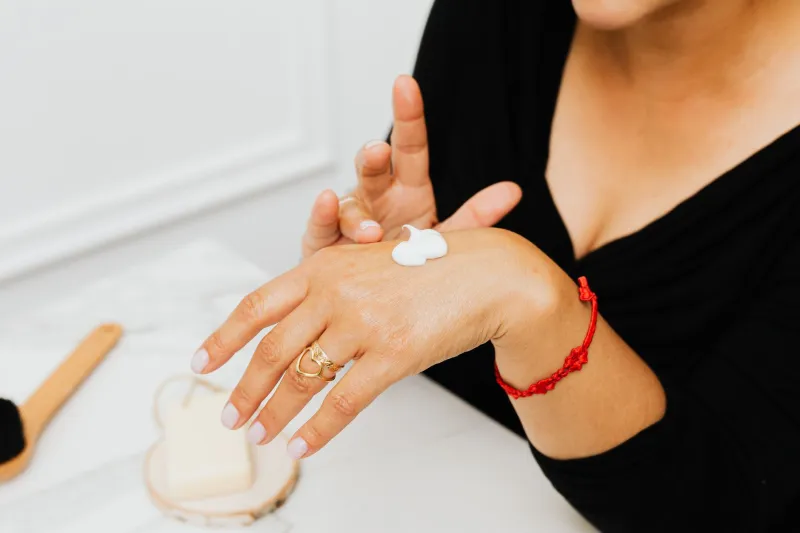
- Blot, don't scrub, then seal. Within sixty seconds of stepping out, apply moisturizer to slightly damp skin. This 'soak and seal' method traps the surface water before it evaporates — arguably the single highest-impact habit in this entire article.
Do Filters Actually Help?
Shower filters — the kind that screw on between the pipe and the showerhead — range from $25 to $80. Most use vitamin C (ascorbic acid) or KDF media to neutralize chlorine and reduce some mineral content. The honest assessment: they won't turn hard water soft, and the evidence for dramatic skin improvements is thin. But if your water smells like a swimming pool or your skin stings after washing, a filter is a low-cost experiment worth trying. Whole-house softeners are the real fix for genuinely hard water, but that's a plumbing decision, not a skincare one.
The Bathroom, Not the Bottle
There's a quiet irony in modern skincare: we spend more than ever on serums and barrier creams, then spend ten minutes every morning undermining them. Clean, thoughtful formulas matter — but so does the environment those formulas have to survive.
Cooler water, shorter showers, and moisturizer on damp skin cost nothing. They're the least glamorous upgrades in beauty, and quite possibly the most effective. Your bathroom shelf can wait. Start with the bathroom.